FOLLOW

The Musically Montessori Tot: "Toddlers-At-Home" Activities

THE MUSICALLY MONTESSORI TOT: Toddlers-At-Home Activities!   

 Did you know that Toddlers respond to musical activities before almost any other activity?  Adding music to your day is my secret to engaging your Montessori Toddler.


Joplin, aged 27 months. Photo by Carolyn Lucento for Magical Movement Company

The Musically Montessori Tot

During our worldwide pandemic, more and more families have been asking me "What do I do all day with my young children at home?"

Recently I have found that the age group that families ask me about most is the toddler group...those adorable two year olds.

"Twosies" are considered a challenging crowd! 

You know...that stage between babyhood and preschoolers. (around 15 months to 36 months of age)

Our Musically Montessori Tots are typically learning to walk and are not fully verbal or completely potty-trained. Yet that "tot" is in constant motion and absorbing information continually. (think: "absorbent mind")

And, I've observed over the decades in my career as a Montessori educator that, the youngest children are keenly responsive to the sounds happening in the environment surrounding them.

Most every baby, no matter where s/he is born, has some form of a rattle that attracts the child's attention immediately and soon becomes the child's way of "making music" when s//he first intentionally grasps the rattle to shake it herself.  

Well, at least,  I consider this"making music!"
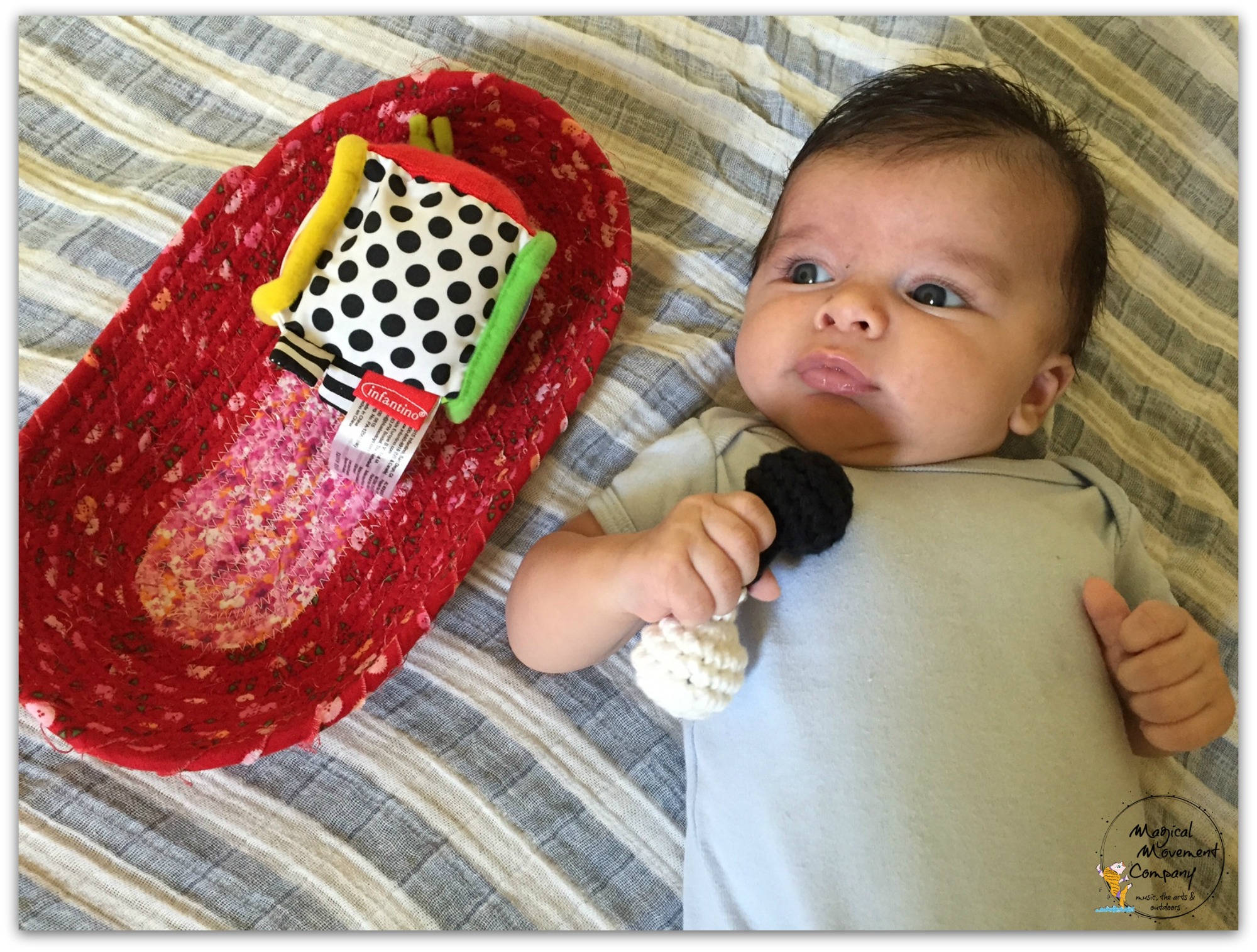
Emilio, aged 2 months. Photo by Amanda Cuartas for Musically Montessori Baby-Ed eCourses

The black & white crocheted baby rattle pictured here is from an Etsy shop and is included in my musical materials list at the end of this blog article. 

Montessori Sensitive Period for Music Begins with Infancy

Studies show that the unborn child responds to sounds, especially music, as early as the second and third trimester of development before birth. 

Infants have delicate hearing at birth and prefer sounds that are lower in pitch.  That is why it is important that we protect the newborn baby from loud and extremely high-pitched sounds. Rather offer lower-pitched sounds made by instruments like the acoustic guitar, and one of my favorites, the mbira, or thumb piano!


Because children from birth through around age 6, have sensitive hearing, they are capable of learning their home language and even multiple languages spoken in the environment.

Likewise, at this time in development, the child is especially responsive to music and musical activities! 
 
Maria Montessori used her observations as a physician, and a teacher, to develop her theories concerning what she titled "sensitive periods" of development in the young child.

"The sense perceptions of even the tiniest infants initiate their psychic development before there can be any questions of its external expressions...  Even though this development takes place in secret, it would be wrong to imagine, as in the case of speech, for example, that it is not happening...  Little by little the ears pick out various sounds and the child's tongue begins to move with a new animation...  The child is passing through a sensitive period: a divine command is breathing upon this helpless being and animating it with its spirit." (The Secret of Childhood, p. 37-45 by Dr. Maria Montessori)


Incorporating Musical Instruments in Your Child's Environment 

In my experience, the youngest children benefit greatly from carefully selected recorded music, but they benefit even more so from live music right in their homes!

When you play your guitar or piano, your dulcimer or flute, for your child, s/he not only feels the vibrations and hears the sound of the music, but s/he also responds by moving.  All the while, your child is absorbing important information, in a sensorial way, from these live music experiences.

Whether you actually play an instrument or not, as a parent you can provide simple rhythm instruments for your baby, toddler, and young child to explore. 

I recommend investing in a selection of pleasant sounding wooden rhythm instruments such as rhythm sticks, a tambourine, castanets, and maracas, along with sweet sounding bells and a triangle. 

I try to steer clear of plastic instruments for young children. First, because very young children explore everything with their mouths, and the safety of plastic is still questionable especially for infants. Secondly, children's instruments that are made of plastic tend to have a harsh sound, as opposed to a sweeter and truer sound of wood or metal. 

Basket of children's rhythm instruments. Photo by Carolyn for Magical Movement Company

There are also many high quality, pitched instruments made for children, that you can introduce to your, child,  first by playing it yourself and then offering it to her to explore making her own sounds...making her own  music!

Here is a 1-minute video showing Emilio at age 8 months, exploring sounds and making music with a lap harp (melody harp) designed for children.


If you happen to be a music freak, like me, you might consider setting up a music corner in your family room to "make music" with each other, especially during these shelter-in-place days of covid 19. 


Music Corner of the Family Room. Photo by Carolyn for Magical Movement Company


Meet Joplin, my favorite little Musically Montessori Tot

A few months ago, I began working with my youngest godchild, Joplin. He and his family are members of our pandemic pod and Joplin comes to my house three days a week to make music with me. He also happens to be the child of one of my former little Montessori students from the 1990's. I first met Joplin's mom when she was a toddler herself!


t o
Musically Montessori Tot "making music" in the family room
Photo by Carolyn for Magical Movement Company

The first day that Joplin came over to my house, I had set out an array of instruments and was looking forward to seeing which ones he would want to explore. 

He went straight for the ukulele!

I was a bit surprised since I thought he would go for one of the many drums I had out...or one of the the barred  instruments with their sturdy mallets.

But, Joplin went for the ukulele and now that is always the very first thing he wants to do when he comes to my house...play the little ukulele!

This video below is a little glimpse of Joplin playing the ukulele in the family room music corner.  I have discovered that having a small selection of quality instruments available to my Montessori Tot, creates an endless variety of  engaging activities right at our finger tips!


My Quick List of Music Resources 

Suggestions 

for the Musically Montessori Tot (& family)


Musically Montessori Tot collection of toddler-friendly rhythm instruments 
Photo by Carolyn for Magical Movement Company

  1. Mbira (thumb piano)
  2. Mostly wooden rhythm instruments set
  3. Ukelele
  4. Montessori style baby rattle
  5. Guitar, Autoharp, Flute, etc (the adults can play these for the child)
  6. Toddler & Infant-friendly instruments by Plan Toys  
  7. Toddler-friendly Orff-Style barred instruments
  8. Recorded music from Frank Leto,  also Elizabeth Mitchell, and Tamara O'Brien (just a FEW artists that I love, and will get you started)

Studio 49 "Easycussion" Xylophone 
Photo by Carolyn for Magical Movement Company

More Resources 

from 

Magical Movement Company & Homebound Montessori


Join my email list and access my Subscribers Freebie Collection
Click the SUBSCRIBE Form on the sidebar of this Blog
Or scroll to the end of this article if you are on a mobile device!


Did you know I have a Teachers Pay Teachers Shop?


Thank you for visiting my Blog today. I hope you have fun with your musically Montessori tot!


Copyright 2020 Carolyn Lucento Magical Movement Company


View Post

Six Dinosaur Activities Featuring Music & The Arts in Montessori

DO YOU KNOW SOMEONE WHO LOVES PLAYING WITH DINOSAUR TOYS? Like...maybe your entire Montessori group or whole neighborhood of kids! 
Photo from Adobe Stock
"DINOSAURS" 
AS PART OF 
THE MONTESSORI CURRICULUM
"Dinosaurs" as a topic in the Montessori Curriculum have always been one of the all-time favorites with my groups, including my current Montessori music classrooms today! Every dinosaur song and movement activity is always a big hit.

This song comes from one of my first introductions to dinosaurs (in the 1970's) when my own children played this album everyday! 
~ "My Name Is Stegosaurus" from Juice Music (original song is from the Album, "Our Dinosaur Friends".1974)


So when I recently discovered that my little 3-yr old grandchild has become enamored with dinosaurs, I stepped right up to the plate and began gathering "Dinosaur Activities" to enhance his cognitive development and have lots of fun, too.

In the Montessori curriculum, dinosaurs are important components of the Lower Elementary "Timeline of Life." In the Montessori Preschool classroom, I have always brought dinosaurs in with the study of Reptiles. (However, nowadays, there are debates about whether dinosaurs should be considered Reptiles or Birds. Actually, dinosaurs have their own "branch" called "Dinosauria.")


HANDS-ON EXPERIENCES
Photo from Adobe Stock

Maria Montessori discovered that children learn through "hands-on experiences." In the Montessori pedagogy, we offer children concrete experiences before we go into more abstract activities. Here is one quote I found at the AMS site, in which Montessori describes to educators what our task is:

"And so we discovered that education is not something which the teacher does, but that it is a natural process which develops spontaneously in the human being. It is not acquired by listening to words, but in virtue of experiences in which the child acts on his environment. The teacher’s task is not to talk, but to prepare and arrange a series of motives for cultural activity in a special environment made for the child."  
From The Absorbent Mind by Maria Montessori 

If it is possible to begin your dinosaur studies with a field trip to a local museum or a "dinosaur park", this will give your young dinosaur enthusiast a somewhat concrete experience with dinosaurs. Most museums have models or actual reconstructions of dinosaur skeletons that can give a child an idea of how large these creatures were. 

"Dinosaur Park" photo from Adobe Stock
In "dinosaur parks" children can view authentic models of dinosaurs. There are even dinosaur "playgrounds" where children can climb, swing, and crawl through play structures that are kid-friendly replicas of dinosaurs.

Children's Museums often have "hands-on activities" related to dinosaurs. My grandchild and I recently went to a local children's museum where there were outdoor "sandpits" for children to dig for "dinosaur bones."


Here are some fun songs to go along with digging for "dinosaur bones: ~ "Them Bones" (Caspar Babypants) ~"Shake Them Bones" (Kidboomers) ~"Fossils" (Carnival of Animals by Camille Saint-Saens


AUTHENTIC TOY MODELS
Photo from Adobe Stock

I first learned the names of many of the most famous dinosaurs when my own children became enamored with dinosaurs way back in the 1970's! 

One of the ways my own children and I learned about the dinosaurs was by collecting authentic child-friendly plastic models of dinosaurs. Along with identification books from the library, we discovered the names of the dinosaurs that the models represented. 


Carnegie Collection of Dinosaur Toys

So, when my youngest grandchild became enamored with dinosaurs, I ordered some authentic models of his favorites: T-Rex, Plesiosaurus, Triceratops, Stegosaurus, Parasaurolophus, and my favorite, Pteranodon. 

Some of the best dinosaur models are at Safari Ltd. Here is a wonderful video showing the quality of their toy line.


TRADITIONAL & BEAUTIFUL 
MONTESSORI ACTIVITY PACKS
Next, I went to the TpT site and I purchased some wonderful resources for creating a "unit of study" for my 3-yr old dinosaur enthusiast. We played lots of games with these materials and I even saved some activities to introduce to him as he gets older.

TpT Pack from Welcome to Mommyhood
TpT Pack from Trillium Montessori

MY "Exploring Dinosaurs" COLLECTION
(Featuring Music & The Arts in Montessori)

LANGUAGE ARTS, DRAMATIC ARTS, FINE ARTS, MUSIC & MOVEMENT, AND FINE ARTS

1. Parts of the Dinosaur Puzzle 
and
Montessori-style 3-Part Cards
(Pre-reading)

Dinosaur Puzzle from Artemex Etsy Shop & 

When I began my search for some classic Montessori "Parts of the Dinosaur" Activities, I ran into some snags. I wanted a puzzle and then 3-Part Cards to go along. 

I was able to find only one puzzle that features the actual parts of the T-Rex. My grandchild likes this puzzle, but it is a bit of a challenge as the parts are not so easy to connect.

Next, I decided to create our own Montessori-style 3-Part Cards and this Activity is part of my "Exploring Dinosaurs" TpT Activity Pack. (seen in the picture above)


2. Montessori-style Command Cards
for
Movement Activities
(Large Motor & Language)

Book available from Amazon
The book, "Stomp, Dinosaur, Stomp" has been a big favorite for us.  So, after reading it day after day,  I decided to  create a fun Montessori-style Activity based on the dinosaur "actions" from the rhymes in the book. ( I created 3 levels of reading for these "command cards.")
One Activity from "Dinosaurs with The Arts" from Magical Movement Company TpT Shop

This Book and my Command Cards are very fun for acting out the motions. We also made the rhyme in the book into a musical story by adding rhythm instruments for the motions and using the stick puppets (see activity below) to tell the story. (Ex: drum for "stomp", tambourine for "swoop. etc.)
3. Exploring "Dinosaur Skeletons" 
Matching Dinosaur Models to their Skeletons
(Practical Life, Sensorial, & 
Pre-reading)
My grandchild loves exploring kinetic sand in his sensory bin. We found some purple (his favorite color) kinetic sand and some plastic miniature dinosaur skeletons on Amazon, and voila! we had a fun "dinosaur dig" right in our own back yard.

We added a few "digging tools" and enhanced the authenticity of this archeological activity. Lots of skills development! 

Kinetic Sand and miniature "Dinosaur Skeletons"


Later, our little one enjoyed matching the skeletons to dinosaur miniatures. 
Matching Dinosaur miniatures with their "Skeletons"

This inspired me to create a Montessori-style matching cards activity for my "Exploring Dinosaurs" TpT Activity Packet.

One Activity from "Dinosaur Activities with The Arts" at Magical Movement Company TpT Shop
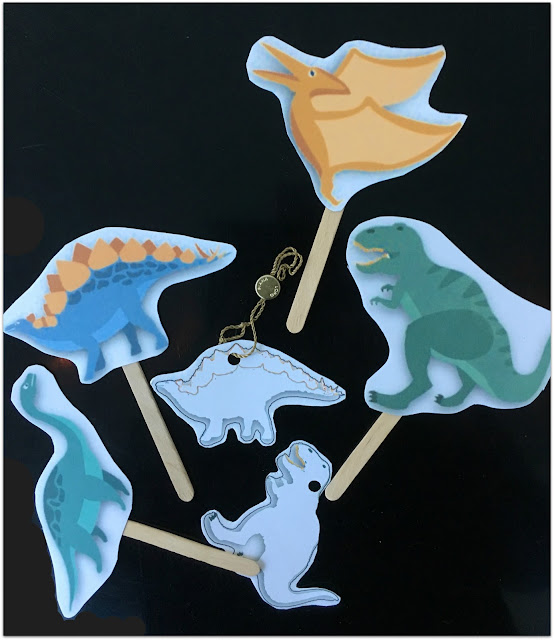
4. Creating Dinosaur Stick Puppets 
or 
Hanging Ornaments
(Arts & Crafts, Fine Motor Practice)
Dinosaur "Puppets & Ornaments" from Dinosaurs with The Arts at Magical Movement Company TpT Shop

Next, I decided to make some stick puppets out of the adorable dinosaur graphics that I purchased at Creative Market.

I pre-cut the dinosaurs and then Jules taped them to craft sticks. Later, he wanted to paint some of the outlined templates and then hang them on the tree! 


5. Performing Musical Stories about Dinosaurs
(Music & Drama)
During my days as a Montessori classroom teacher, we always enjoyed singing various dinosaur songs (see suggestions below) and then acting out the motions in the songs. 

We even created impromptu "shows" that we developed into full-fledged productions that we performed for families and other classrooms.

Photo from Adobe Stock

In my "Exploring Dinosaurs" Activity Pack,  I have included a Dinosaur Story that you can develop with your group of dinosaur-loving musicians. My grandchild, Jules, loved "performing" this story over and over. He played the Glockenspiel for the rain drops and the fun part for him was when I put the dinosaur models in their "cave" when the rain storm came!
I discovered some really interesting music suitable for background music for impromptu performances: ~ "Ancient Dinosaur/ Prehistoric Times" from Amazon. And, this recording from Laurie Berkner "We Are The Dinosaurs" is always a great choice for a dinosaur "parade."

6. Exploring Fine Art Historical Pictures of Dinosaurs 
(Fine Arts)

I've included in my "Exploring Dinosaurs" TpT Activity Pack, a set of twenty "Dinosaur Art" Pictures from traditional oil paintings created by National Geographic artists to ancient renditions in prehistoric caves & temples, to fun pop art and even beautiful street art and beach sand art!
Art by Charles Knight from Public Domain

My little one, Jules, was fascinated with these Art pieces and we had lots of fun exploring them. We even chose one to display in a frame.
Thank you again for visiting my blog today. I hope you have gotten lots of ideas for your dinosaur-loving kids! If you would like to provide even more dinosaur activities for your group, I invite you to check out my Teachers Pay Teachers (TpT) "Exploring Dinosaurs" Activity Pack.

"EXPLORING DINOSAURS WITH MUSIC & THE ARTS"


P.S. Have you seen my newest free resources at Magical Movement Company's "Subscribers Freebie Collection"?


View Post

Montessori Baby-Ed: Musical Development in the First Year

DID YOU KNOW YOU CAN ENCOURAGE YOUR CHILD'S MUSICAL DEVELOPMENT FROM THE VERY BEGINNING?

(photo credit)
If you look closely at the classic stages of development in Baby's first year, you can see that they correspond beautifully with creating a solid foundation in music.


And, it's just about effortless!

Baby's respond to sound even before they are born. 
Ask any pregnant mom, when she goes to a live music concert if she feels her baby moving to the music!

After Baby is born, we find that she continues to respond to music, and she especially loves the sound of her family members when they sing her a lullaby at night.

In fact, almost every toy that is engaging for a baby has some kind of jingly sound or rattling noise inside. 

And, what baby doesn't love the sound of a sweet and gentle hand crank music box?

THE IMPORTANCE OF A RATTLE
Photo from Adobe Stock

Very early on, your baby will begin to grasp objects, and one of the first things we offer her is a rattle.

I like the nice wooden ones that have a gentle sound, not harsh and loud, but soft like the rain falling.

Emilio, a Montessori Baby-Ed participant, enjoying his rattle at age 2 months. 
When you offer your baby a nice wooden rattle, you are giving him/her the first opportunity to "make music." You probably have learned by now, that early musical experiences have the most benefit for the child when she is given ways to make music. Listening to music is fine, but making music builds the brain!

When your baby makes music with a rattle, she begins to explore the concept of "cause and effect." 

She also develops the small muscles of the hands and fingers, that are so important for writing, for cutting with scissors, and later for playing an instrument like the piano.

The sensory experience of shaking a rattle, gives Baby opportunities for developing auditory discrimination skills that play an important part in language development.

You can enrich the musical experience for your baby by shaking a percussion instrument along with her. Then, you can play a steady beat which will stimulate her senses to recognize and eventually to play a steady beat herself.

If you sing a simple song along with playing the instrument, then your baby gets the added benefits of hearing your voice (which she loves) and also how her home language sounds.

Photo from Adobe Stock

And, the sound that a little percussion instrument makes, will entice your baby to creep over and check it out herself!

WHEN BABY CAN SIT ON HER OWN, THEN HER HANDS ARE FREE TO WORK & PLAY

Photo from Adobe Stock

In the next classic stage of the child's development, your baby has become mobile and can sit up on her own. She will spy an object and then head right for it! (especially if it makes a fun sound)

As sitting becomes more and more refined, Baby discovers that s/he has her hands free to manipulate the object that she crawled over to explore.

Emilio, at age 8 months, playing his Chime Bar from MONTH FOUR of Montessori Baby-Ed 
Providing musical objects (instruments) in Baby's environment, gives her the opportunity to not only use her large motor skills to get over to the object, but also to practice with her small muscle development as she "plays" the instrument. 

There is hand-eye coordination developing, along with sensory learning through auditory & kinesthetic experiences.

Once again, you can enhance the learning by playing and singing along with your baby.

WHEN BABY CAN STAND ON HER OWN, SHE CAN 
DANCE TO THE MUSIC

By the time, your baby has arrived at the next classic stage, the standing/walking stage, s/he has celebrated her first birthday! 

She has also passed through a major milestone of life. She is an independent being and she now realizes it!

With more and more confidence in her abilities, Baby responds to music by not only singing along, but also by dancing to the beat. 

You can encourage Baby's musical development by inviting her to move to the music. You can model how to stomp, or march, or tiptoe when music is playing in the environment. Eventually, baby will have mastered the moves of her own little dance. 

Invite your baby to twirl a colorful ribbon while she moves to the music (Photo by Jeri-Jo Idarius)

Spontaneously moving to music offers your baby practice with the large muscles of the legs and back that are important for walking, for running, and later for all kinds of athletics, including things like swimming, gymnastics & dance!

When you put on some of your favorite music and then dance, dance, dance...you not only release the stress of the day, you also bond with your baby in a sweet and happy way.

Want to learn more about what you can do to enhance your baby's musical development in her first year?

My newest eCourses are now open for enrollment. 

You can enroll in just one month...six months... 
or SAVE and enroll in my twelve month BUNDLE!


Thank you for visiting my blog today. I hope you got some inspiration for making music with your baby!


View Post
Previous PostOlder Posts Home
BLOGGER TEMPLATES BY pipdig