FOLLOW

Musically Montessori Tot: Where The Wild Things Are Activities "Vlog"

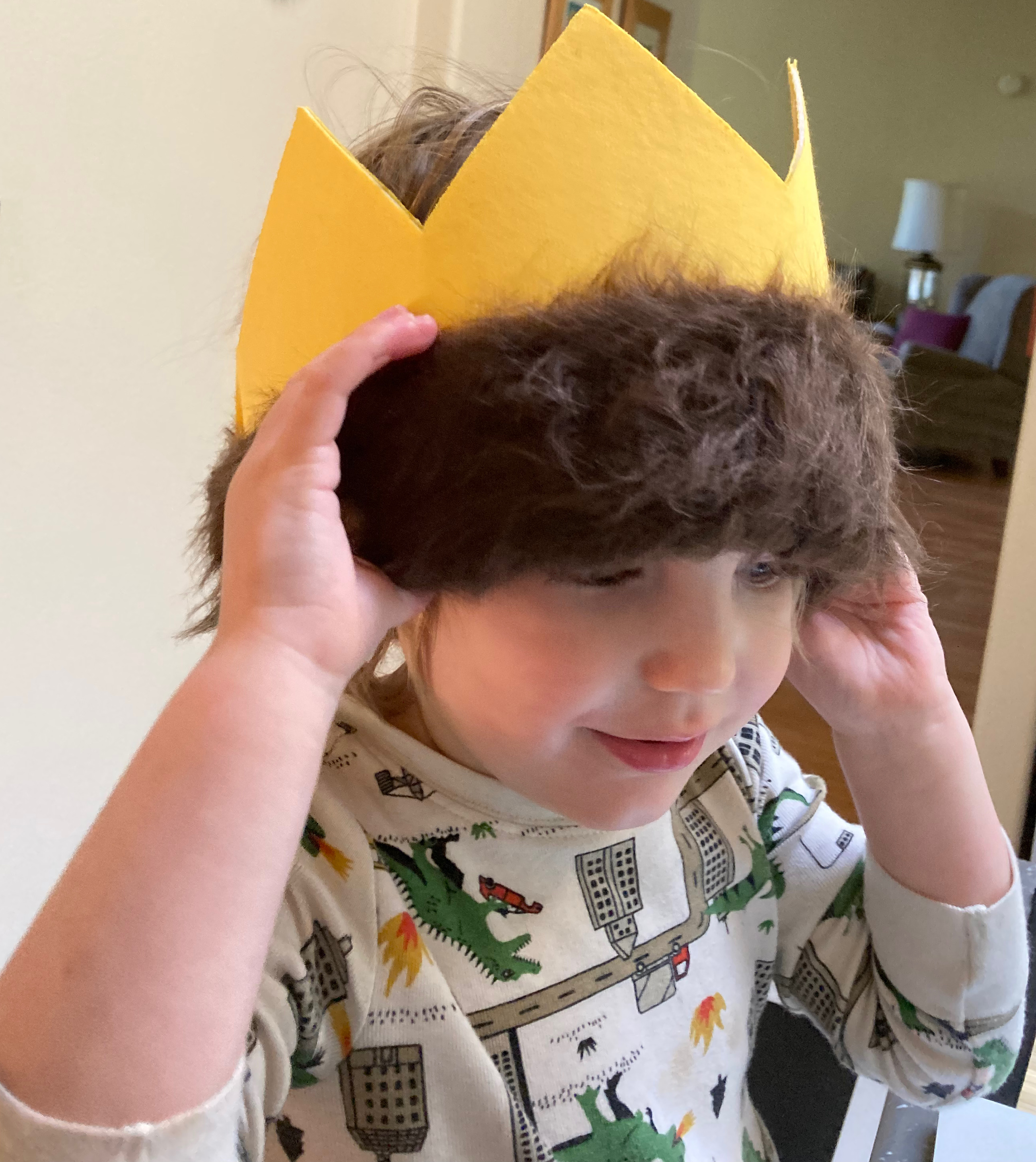
DO YOU HAVE A LITTLE WILD THING AT YOUR HOUSE?

Where The Wild Things Are at Magical Movement Company

 My "Historic Wild Things" Story

If you are fortunate like me, you have grandchildren, nieces, nephews, and even "godchildren."

Joplin, one of the little ones in my life, happens to be the youngest of one of my former preschool students in my Montessori program of the 1990's, Albion Children's House.   

Joplin's mom brought Joplin over to my house every week during the pandemic and he and I had lots of fun making music during those unusual times. 

His mom always tells me that her favorite memories of her own preschool years, were of our activities preparing for our little "production" of the story, "Where The Wild Things Are."  

So, of course, Joplin and I enjoyed tremendously our own fun-filled months of exploring Maurice Sendak's classic picture book, Where The Wild Things Are.


Today's Video Story of The Wild Things with Joplin

I've actually created a lovely video capturing some of our "wild thing" activities, and I've even listed some of my favorite resources for you to create your own "Where The Wild Things Are" month of activities for your little ones.

You can view the video at this link: https://youtu.be/ZbBOftHiGjY

 Or click on this video to see our Wild Things activities:


How The Activities Benefit the Child's Skills Development


Literacy Skills: Hearing & seeing the words and repetition/memorization of the story 
Small Motor Skills: Creating masks, art scribbles, manipulating puppets, and playing instruments
Large Motor Skills: Drama-play of the actions in the story 
Cognitive Skills: As a child grows older, s/he begins to understand the difference between "real" and "imaginary"


Resources for Creating Your Own 

"Wild Things" Activities

 Click on each link to find where I got the things we used in our activities. I receive a compensation for mentioning these. Thanks for your support!
I hope you found some inspiration for yourself and the little wild things in your life!

Have you checked out my Musically Montessori eCourses?


ACCESS MY SUBSCRIBERS FREEBIE COLLECTION WITH 30+ FREE DIGITAL DOWNLOADS, INCLUDING MY EBOOK


SUBSCRIBE TO MY EMAIL LIST ON THE SIDEBAR OF THIS BLOG OR AT THE END OF THIS POST IF YOU ARE ON A MOBILE DEVICE


Thank you very much for visiting my Blog today. Have fun exploring! Just type in what you are looking for in the "search" bar.


View Post

Musically Montessori Tot: Practical Life Environment for Toddlers

ARE YOU SEARCHING FOR DAILY "AT-HOME  ACTIVITIES" FOR YOUR TODDLER?

Start with an appropriate and engaging environment based on Montessori principles. And, please don't forget my secret ingredient: music!  


2-yr old Joplin spreading peanut butter on his crackers. Photo by Carolyn for Magical Movement Company

What Do Toddlers Want? 

Throughout each day, our Musically Montessori Tots are constantly seeking to take care of themselves, just like all the adults around them!
 
They get hungry and want to eat. 

They get restless and want to go outdoors.

They are curious and want to explore.

They are capable and want to master basic skills.

They are always in motion and constantly learning through their senses.

We can make all this easier for our toddlers and ourselves, by preparing an environment that is appropriate and voila! it will also be engaging.

****FIRST RULE OF SAFETY: CLOSELY SUPERVISE YOUR TODDLER AT ALL TIMES**** 

Setting Up An Appropriate Toddler Environment 

Based On Montessori Principles

In my Montessori Tot home environment, I have planned for five basic areas of learning: 

1) Practical Life
 
2) Outdoor Classroom
 
3) Hands-on Sensorial Experiences 

4) "Shelf Works" designed to enhance cognitive development (activities that prepare the child for reading, writing, math, and the sciences) 
 
5) Aesthetics & The Arts through Cultural awareness. 

This blog article features the first area of my Musically Montessori Tot Environment: Practical Life. 

Here, I will present some of the ways I have set up these daily activities in my home environment.

Eating,  Self-Care, and "Practical Life" Activities

Montessori Toddler Dining Activities

2-yr old Joplin spreading peanut butter on his crackers. Photo by Carolyn for Magical Movement Company

No matter what else happens during your day, eating is definitely going to happen! 

And young children need to eat frequently and in healthy ways.

The first Montessori area I set up for my Montessori Tot,  Joplin, was the "dining area." 

The sunny breakfast nook in my kitchen has been transformed into Joplin's Practical Life and Art areas. So, there is a child-size table, chairs, and shelving to hold the trays of activities. Since this set-up is in the kitchen, there is a sink nearby (for quick clean up) and the floors are laminate and "mop-able." 

Montessori Toddler Environment featuring the "dining area" and Practical Life activities 
(photo by Carolyn for Magical Movement Company)
 
When Joplin arrives in the morning, he loves to play music with me in the family room for a bit, then it's off to the dining area for a morning snack! You can check out some of our Montessori Tot music activities in my blog article here: The Musically Montessori Tot: "Toddlers-At-Home" Activities

 Preparation and Procedures

Over the past few weeks, Joplin, who is 2, has been learning the procedures for dining in his child-friendly environment. 

Before he arrives,  I set up his table with a little table cloth, placemat, and pitcher of water with a small drinking glass. I also fill the little snack bowls on the shelf with fresh fruit or veggies, crackers, peanut butter, cream cheese, etc. (If there is a peanut butter allergy, you can offer cream cheese, humus, tahini, or even butter/margarine as a spread alternative.)  

After washing hands, Joplin enjoys checking out what I have put in his little snack bowls on the Practical Life shelf next to his table. 

Components of a Montessori Toddler Environment featuring the "dining area" & Practical Life activities (photo by Carolyn for Magical Movement Company)

Next, he chooses his plate and little butter knife for spreading, then he takes it to his place at the table. 

Then, Joplin carries each snack bowl to his place mat and sets them up next to his plate and spreading knife.

He pulls his chair out a bit and sits down to eat. 

All along, I am there to assist him and I even sit there with him and have my morning tea. I have discovered that Joplin always wants me to sit and eat with him! 

When he has spread the peanut butter or cream cheese on crackers or sliced fruit, he proudly eats it! 

At some point, Joplin chooses his tiny drinking glass and then carefully pours water from the child-size pitcher into his glass. 

Joplin's skills have quickly developed over the weeks.
 
You Can Practice Patience and Consistency in 
Guiding Your Montessori Tot

In the beginning, Joplin wanted to take a cracker from the snack tray and carry his snack around the house checking things out. I would gently and diligently guide him to the snack table saying, "Back to the kitchen, please." 

Nowadays, Joplin always brings his snack (or lunch plate) to his little table and sits while he is eating. That is because I decided ahead of time how to set up the environment and then consistently guided him in the procedures I had decided upon, as well.

Decide On Your Procedures Beforehand
 
Deciding on procedures is a classic part of the general setting up of the Montessori environment. So, before your child begins to interact with this environment, it is important for you, as the educator, to decide HOW things will be implemented. What will your procedures be? This is a secret to success!

With Joplin, I also sit with him at the table...he enjoys that! We look out the window and chat about the birds or the clouds in the sky.  In your home environment, you can certainly set up dining at the family table for your toddler's snack. You could have the snack tray and toddler placemat set up on the family table and your Tot can proceed by herself to butter the crackers and pour her own water. 

Meals together with your Montessori Tot are an excellent time for teaching table manners, developing vocabulary, and modeling the skills necessary for small motor refinement. 

Mealtime is an opportunity for the Montessori Toddler to develop small motor skills 
along with skills in grace & courtesy (photo by Carolyn for Magical Movement Company)

Make Your Montessori Tot Environment "Child Friendly"
Another important component of successfully creating a Montessori Tot environment is making things manageable for the child. (ex: child-size utensils located near the actual eating place.) Joplin knows his child-size plates and silverware are in a basket next to the dining table. As well, there is a small pitcher of fresh water (partially filled with a small amount of water) located on the table next to a child-sized drinking glass.  There is even a tiny, tiny salt shaker that he really enjoys!

To create "ambience", I like to include a little flower bouquet in a vase on the table. It is lovely if you choose to turn on a little electric candle and even play some soft background music like you might find in a downtown cafe!  

If you like, you can begin the "dining experience" with a little "thank you song". This will not only add a musical element to the meal, but also gives everyone a moment to quietly and respectfully prepare to eat. You will hear my favorite "meal song" at the end of this 3 minute video: "Montessori Toddler Dining Set-up":


Montessori Toddler Self-Care

During childhood, we are all learning how to do things and master the skills necessary for taking care of ourselves. This is an important part of the Montessori pedagogy. 
“The essence of independence is to be able to do something for one’s self.” The Absorbent Mind, by Maria Montessori
When Dr. Montessori opened the first Montessori House of Children in Rome in 1907, she discovered that the little children arriving at the school each morning, were unbathed and dirty. So the first activities Montessori introduced were washing hands, feet, and faces. The Practical Life exercises of self-care! 

Joplin, my Montessori Tot,  is 27 months old and he is very physically capable. He also wants to do everything himself and this is typical of young children. Mastering skills and gaining independence are important milestones in a child's typical development. 

In the bathroom, we have set up a way for Joplin to reach the sink to wash his hands and also to brush his teeth. He also knows how to pump the hand soap and how to dry his hands with his own little hand towel. 

Everything he needs to clean his hands is there within his reach. There is a step stool so that he can reach the faucet. I still turn the water on for him and I also fill the sink so that he can wash his hands. But, Joplin himself is gaining skills daily in this process.  

My role: encourage...encourage...encourage!

Child-friendly environment for the Montessori Tot's self-care developing skills 
(photo by Carolyn for Magical Movement Company)


Building Self-Care Skills Through Imaginative Play  
Montessori Tot in his self-designed rocking cradle for practicing self-care skills 
(photo by Carolyn at Magical Movement Company)

Joplin decided that he would turn the wooden balance board into a little "rocking cradle" for himself. (Adorable!)  

Then, we opened up the basket of baby dolls and accoutrements. He immediately began to practice skills in brushing hair, brushing teeth, and later dressing and undressing the dollies.

Montessori Tot creating his own activity to practice self-care skills 
(Photo by Carolyn for Magical Movement Company)

Where Does Your Montessori Tot Hang Her Jacket?

Another area of  self-care that is important in the Montessori Tot environment is orderliness: Where are the snack items kept? Where is the hair brush stored? Where do we put our boots and jacket when we enter the house?

When personal care items are kept at the toddler's height and in the most convenient location for the child, then your Montessori Tot will be successful in gaining self-care skills necessary for independence. 

Montessori Tot's low hook for hanging jacket and backpack 
(photo by Carolyn at Magical Movement Company)

At our front door, we take off our shoes and there is a rack for our jackets and shoes, back packs, covid masks & face shields. 

The lower hooks are at Joplin's height, so that he can reach them himself. And, that is often how he lets me know he wants to go outside for a walk. He goes to the lower hooks and takes down his jacket and backpack, and even his face shield.  Then, he slips on his boots and he's ready! 

Everyday, we are working on Practical Life skills like putting on and zipping jackets, velcro-ing shoes, putting on gloves and caps.  Soon, we will be refining the skills for the big step of going to the toilet! (I'll keep you posted)  

Montessori Toddler "Care of Environment"

If you know any child who is able to walk & toddle around, then you know how much they want to push around a broom, or vacuum cleaner whenever they see the adults around them engaging in these activities.

In the Montessori environment, the young child is offered child-size tools located at the child's height. This gives the child the opportunity to practice the skills for caring for the environment.  
Montessori Tot's housekeeping tools for care of the environment 
(photo by Carolyn at Magical Movement Company)

In our Montessori Tot environment, I have set up a rack for a child-size broom, dust pan, duster and swiffer mop.  Joplin can access these tools anytime he likes, and when there is a spill, he can help clean up! 

Of course, I clean up along side Joplin, and I do most of it...but he is getting a message from me that he can take responsibility for his spills and also keep order in his environment. 

Plus, we have fun cleaning together!

Montessori Tot taking care of the houseplants in the environment 
(photo by Carolyn for Magical Movement Company)

Joplin also helps me maintain the houseplants and loves to give them a daily spritz. He also has a small watering can for caring for the plants.

In my upcoming post featuring the Toddler Outdoor Classroom, you will see more "care-of-environment activities" that maintain the outdoor environment, such as filling the birdbath, washing windows, sweeping and raking, and cleaning bird feeders. 

Also, we always sing simple little songs (that we make up) about cleaning up, brushing teeth, and just about anything we do daily!

RESOURCES

Here is a quick list of Montessori Practical Life resources I recommend:

1. Child-size plates, silverware, glasses & pitcher from Montessori Services
2. Montessori Printed Dining Mat from montessorivita
4. Wooden Balance Board on Amazon
5. Child-size cleaning tools from Montessori Services or Lakeshore
6. Child-size plant care tools from Montessori Services
7. Music for everyday activities from Frank Leto 

 MORE RESOURCES FROM ME

SUBSCRIBE TO MY EMAIL LIST AND ACCESS MY FREEBIE COLLECTION INCLUDING MY eBOOK


Thank you again for visiting my blog today. I hope you have gotten some helpful ideas for engaging your Montessori Tot. 


View Post

The Musically Montessori Tot: "Toddlers-At-Home" Activities

THE MUSICALLY MONTESSORI TOT: Toddlers-At-Home Activities!   

 Did you know that Toddlers respond to musical activities before almost any other activity?  Adding music to your day is my secret to engaging your Montessori Toddler.


Joplin, aged 27 months. Photo by Carolyn Lucento for Magical Movement Company

The Musically Montessori Tot

During our worldwide pandemic, more and more families have been asking me "What do I do all day with my young children at home?"

Recently I have found that the age group that families ask me about most is the toddler group...those adorable two year olds.

"Twosies" are considered a challenging crowd! 

You know...that stage between babyhood and preschoolers. (around 15 months to 36 months of age)

Our Musically Montessori Tots are typically learning to walk and are not fully verbal or completely potty-trained. Yet that "tot" is in constant motion and absorbing information continually. (think: "absorbent mind")

And, I've observed over the decades in my career as a Montessori educator that, the youngest children are keenly responsive to the sounds happening in the environment surrounding them.

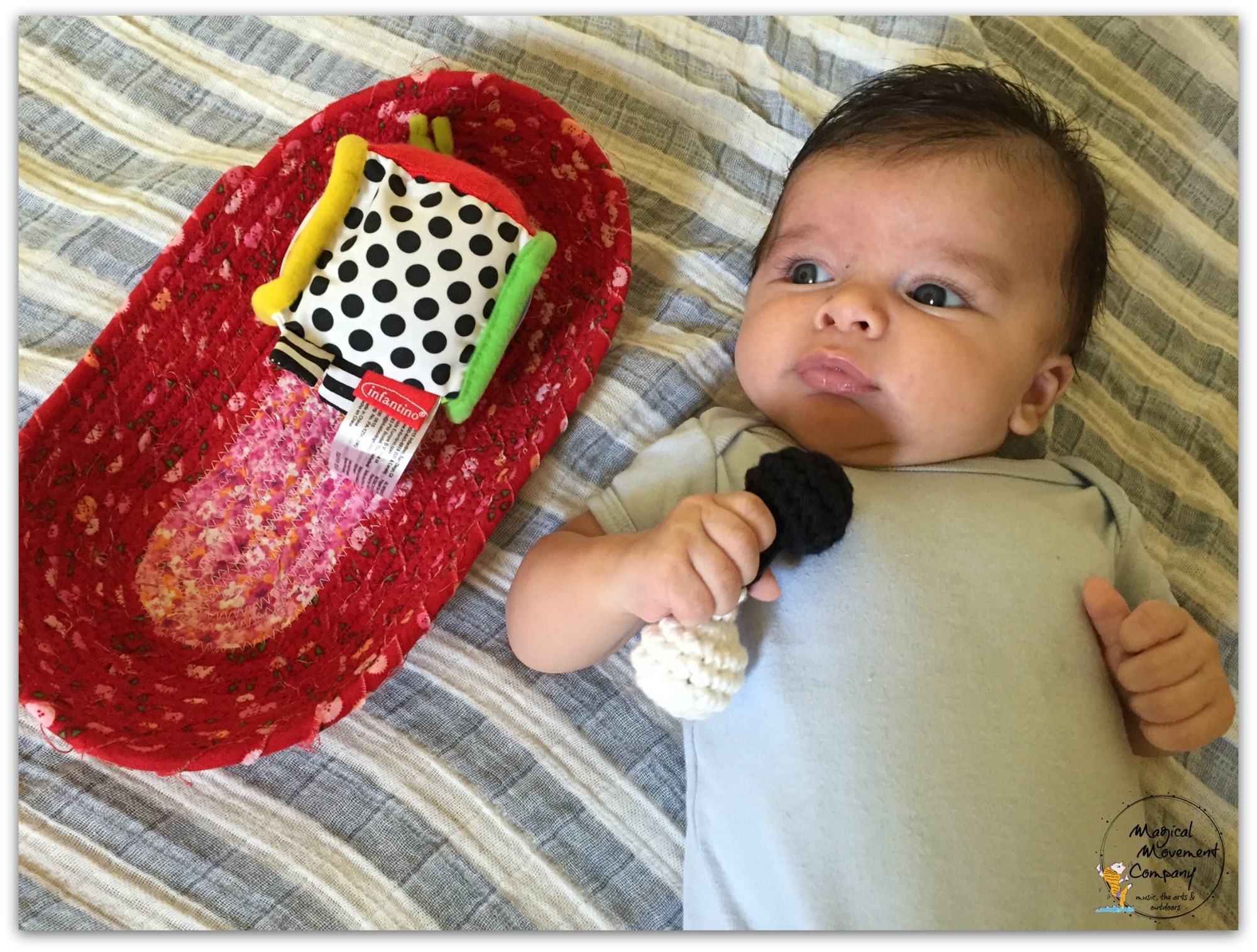
Most every baby, no matter where s/he is born, has some form of a rattle that attracts the child's attention immediately and soon becomes the child's way of "making music" when s//he first intentionally grasps the rattle to shake it herself.  

Well, at least,  I consider this"making music!"

Emilio, aged 2 months. Photo by Amanda Cuartas for Musically Montessori Baby-Ed eCourses

The black & white crocheted baby rattle pictured here is from an Etsy shop and is included in my musical materials list at the end of this blog article. 

Montessori Sensitive Period for Music Begins with Infancy

Studies show that the unborn child responds to sounds, especially music, as early as the second and third trimester of development before birth. 

Infants have delicate hearing at birth and prefer sounds that are lower in pitch.  That is why it is important that we protect the newborn baby from loud and extremely high-pitched sounds. Rather offer lower-pitched sounds made by instruments like the acoustic guitar, and one of my favorites, the mbira, or thumb piano!


Because children from birth through around age 6, have sensitive hearing, they are capable of learning their home language and even multiple languages spoken in the environment.

Likewise, at this time in development, the child is especially responsive to music and musical activities! 
 
Maria Montessori used her observations as a physician, and a teacher, to develop her theories concerning what she titled "sensitive periods" of development in the young child.

"The sense perceptions of even the tiniest infants initiate their psychic development before there can be any questions of its external expressions...  Even though this development takes place in secret, it would be wrong to imagine, as in the case of speech, for example, that it is not happening...  Little by little the ears pick out various sounds and the child's tongue begins to move with a new animation...  The child is passing through a sensitive period: a divine command is breathing upon this helpless being and animating it with its spirit." (The Secret of Childhood, p. 37-45 by Dr. Maria Montessori)


Incorporating Musical Instruments in Your Child's Environment 

In my experience, the youngest children benefit greatly from carefully selected recorded music, but they benefit even more so from live music right in their homes!

When you play your guitar or piano, your dulcimer or flute, for your child, s/he not only feels the vibrations and hears the sound of the music, but s/he also responds by moving.  All the while, your child is absorbing important information, in a sensorial way, from these live music experiences.

Whether you actually play an instrument or not, as a parent you can provide simple rhythm instruments for your baby, toddler, and young child to explore. 

I recommend investing in a selection of pleasant sounding wooden rhythm instruments such as rhythm sticks, a tambourine, castanets, and maracas, along with sweet sounding bells and a triangle. 

I try to steer clear of plastic instruments for young children. First, because very young children explore everything with their mouths, and the safety of plastic is still questionable especially for infants. Secondly, children's instruments that are made of plastic tend to have a harsh sound, as opposed to a sweeter and truer sound of wood or metal. 

Basket of children's rhythm instruments. Photo by Carolyn for Magical Movement Company

There are also many high quality, pitched instruments made for children, that you can introduce to your, child,  first by playing it yourself and then offering it to her to explore making her own sounds...making her own  music!

Here is a 1-minute video showing Emilio at age 8 months, exploring sounds and making music with a lap harp (melody harp) designed for children.


If you happen to be a music freak, like me, you might consider setting up a music corner in your family room to "make music" with each other, especially during these shelter-in-place days of covid 19. 


Music Corner of the Family Room. Photo by Carolyn for Magical Movement Company


Meet Joplin, my favorite little Musically Montessori Tot

A few months ago, I began working with my youngest godchild, Joplin. He and his family are members of our pandemic pod and Joplin comes to my house three days a week to make music with me. He also happens to be the child of one of my former little Montessori students from the 1990's. I first met Joplin's mom when she was a toddler herself!


t o
Musically Montessori Tot "making music" in the family room
Photo by Carolyn for Magical Movement Company

The first day that Joplin came over to my house, I had set out an array of instruments and was looking forward to seeing which ones he would want to explore. 

He went straight for the ukulele!

I was a bit surprised since I thought he would go for one of the many drums I had out...or one of the the barred  instruments with their sturdy mallets.

But, Joplin went for the ukulele and now that is always the very first thing he wants to do when he comes to my house...play the little ukulele!

This video below is a little glimpse of Joplin playing the ukulele in the family room music corner.  I have discovered that having a small selection of quality instruments available to my Montessori Tot, creates an endless variety of  engaging activities right at our finger tips!


My Quick List of Music Resources 

Suggestions 

for the Musically Montessori Tot (& family)


Musically Montessori Tot collection of toddler-friendly rhythm instruments 
Photo by Carolyn for Magical Movement Company

  1. Mbira (thumb piano)
  2. Mostly wooden rhythm instruments set
  3. Ukelele
  4. Montessori style baby rattle
  5. Guitar, Autoharp, Flute, etc (the adults can play these for the child)
  6. Toddler & Infant-friendly instruments by Plan Toys  
  7. Toddler-friendly Orff-Style barred instruments
  8. Recorded music from Frank Leto,  also Elizabeth Mitchell, and Tamara O'Brien (just a FEW artists that I love, and will get you started)

Studio 49 "Easycussion" Xylophone 
Photo by Carolyn for Magical Movement Company

More Resources 

from 

Magical Movement Company & Homebound Montessori


Join my email list and access my Subscribers Freebie Collection
Click the SUBSCRIBE Form on the sidebar of this Blog
Or scroll to the end of this article if you are on a mobile device!


Did you know I have a Teachers Pay Teachers Shop?


Thank you for visiting my Blog today. I hope you have fun with your musically Montessori tot!


Copyright 2020 Carolyn Lucento Magical Movement Company


View Post

Montessori Baby-Ed: Musical Development in the First Year

DID YOU KNOW YOU CAN ENCOURAGE YOUR CHILD'S MUSICAL DEVELOPMENT FROM THE VERY BEGINNING?

(photo credit)
If you look closely at the classic stages of development in Baby's first year, you can see that they correspond beautifully with creating a solid foundation in music.


And, it's just about effortless!

Baby's respond to sound even before they are born. 
Ask any pregnant mom, when she goes to a live music concert if she feels her baby moving to the music!

After Baby is born, we find that she continues to respond to music, and she especially loves the sound of her family members when they sing her a lullaby at night.

In fact, almost every toy that is engaging for a baby has some kind of jingly sound or rattling noise inside. 

And, what baby doesn't love the sound of a sweet and gentle hand crank music box?

THE IMPORTANCE OF A RATTLE
Photo from Adobe Stock

Very early on, your baby will begin to grasp objects, and one of the first things we offer her is a rattle.

I like the nice wooden ones that have a gentle sound, not harsh and loud, but soft like the rain falling.

Emilio, a Montessori Baby-Ed participant, enjoying his rattle at age 2 months. 
When you offer your baby a nice wooden rattle, you are giving him/her the first opportunity to "make music." You probably have learned by now, that early musical experiences have the most benefit for the child when she is given ways to make music. Listening to music is fine, but making music builds the brain!

When your baby makes music with a rattle, she begins to explore the concept of "cause and effect." 

She also develops the small muscles of the hands and fingers, that are so important for writing, for cutting with scissors, and later for playing an instrument like the piano.

The sensory experience of shaking a rattle, gives Baby opportunities for developing auditory discrimination skills that play an important part in language development.

You can enrich the musical experience for your baby by shaking a percussion instrument along with her. Then, you can play a steady beat which will stimulate her senses to recognize and eventually to play a steady beat herself.

If you sing a simple song along with playing the instrument, then your baby gets the added benefits of hearing your voice (which she loves) and also how her home language sounds.

Photo from Adobe Stock

And, the sound that a little percussion instrument makes, will entice your baby to creep over and check it out herself!

WHEN BABY CAN SIT ON HER OWN, THEN HER HANDS ARE FREE TO WORK & PLAY

Photo from Adobe Stock

In the next classic stage of the child's development, your baby has become mobile and can sit up on her own. She will spy an object and then head right for it! (especially if it makes a fun sound)

As sitting becomes more and more refined, Baby discovers that s/he has her hands free to manipulate the object that she crawled over to explore.

Emilio, at age 8 months, playing his Chime Bar from MONTH FOUR of Montessori Baby-Ed 
Providing musical objects (instruments) in Baby's environment, gives her the opportunity to not only use her large motor skills to get over to the object, but also to practice with her small muscle development as she "plays" the instrument. 

There is hand-eye coordination developing, along with sensory learning through auditory & kinesthetic experiences.

Once again, you can enhance the learning by playing and singing along with your baby.

WHEN BABY CAN STAND ON HER OWN, SHE CAN 
DANCE TO THE MUSIC

By the time, your baby has arrived at the next classic stage, the standing/walking stage, s/he has celebrated her first birthday! 

She has also passed through a major milestone of life. She is an independent being and she now realizes it!

With more and more confidence in her abilities, Baby responds to music by not only singing along, but also by dancing to the beat. 

You can encourage Baby's musical development by inviting her to move to the music. You can model how to stomp, or march, or tiptoe when music is playing in the environment. Eventually, baby will have mastered the moves of her own little dance. 

Invite your baby to twirl a colorful ribbon while she moves to the music (Photo by Jeri-Jo Idarius)

Spontaneously moving to music offers your baby practice with the large muscles of the legs and back that are important for walking, for running, and later for all kinds of athletics, including things like swimming, gymnastics & dance!

When you put on some of your favorite music and then dance, dance, dance...you not only release the stress of the day, you also bond with your baby in a sweet and happy way.

Want to learn more about what you can do to enhance your baby's musical development in her first year?

My newest eCourses are now open for enrollment. 

You can enroll in just one month...six months... 
or SAVE and enroll in my twelve month BUNDLE!


Thank you for visiting my blog today. I hope you got some inspiration for making music with your baby!


View Post
Previous PostOlder Posts Home
BLOGGER TEMPLATES BY pipdig